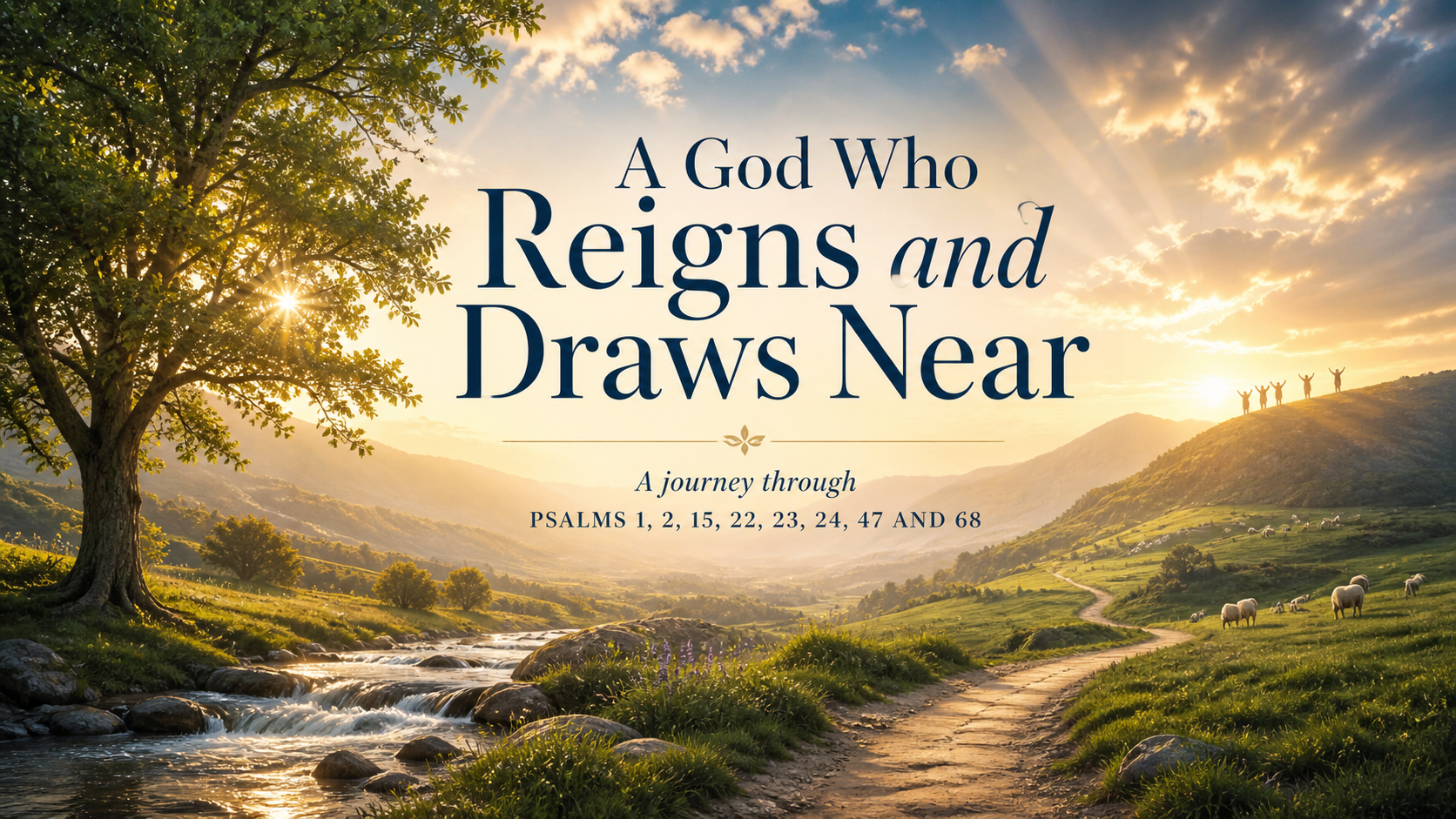
A God Who Reigns and Draws Near
A journey through Psalms 1, 2, 15, 22, 23, 24, 47 and 68
The Psalms are one of the most honest books in the Bible. They hold together celebration and lament, confidence and doubt, great sweeping visions of God's Kingdom and the quiet intimacy of a shepherd with his sheep. If you want to know what it looks like to walk honestly with God — in the good times and the hard ones — the Psalms are the place to go.
Eight Psalms in particular — 1, 2, 15, 22, 23, 24, 47 and 68 — cover more ground together than you might expect. They take on the big questions: How should I live? Who is God really? What do I do when I'm falling apart? What does it mean to worship? They show us a God who is both bigger than we imagined and closer than we feared.
Two Ways to Live
Psalm 1 opens the whole collection with a choice. There are two paths in front of every person — the way of the righteous and the way of the wicked — and the difference comes down to where you put your roots.
The person who delights in God's Word, who reads it, chews on it, returns to it, is described as "like a tree planted beside flowing streams of water that bears its fruit in its season and whose leaf does not wither. Whatever he does prospers" (Psalm 1:3, CSB). That's not a promise of easy circumstances. It's a promise of deep rootedness — the kind that holds when life gets hard.
The wicked, by contrast, are like chaff — no roots, no weight, blown away. It's a stark contrast, but Psalm 1 isn't being harsh for the sake of it. It's being honest. The choices we make about what we give our attention to — what we meditate on, what we fill our minds with — shape who we become. That's an uncomfortable question in a world designed to keep us scrolling. We are constantly being formed by something. Psalm 1 just asks: what?
"Blessed is the man who does not walk in the counsel of the wicked… but his delight is in the law of the Lord, and he meditates on it day and night." — Psalm 1:1–2, CSB
God Is Not Threatened
From the personal, Psalm 2 takes us to the global. The nations are in uproar. Rulers are plotting. The powerful are pushing back against God. It can feel like the world is spinning out of control.
But look at God's response: "The one enthroned in heaven laughs" (Psalm 2:4, CSB). Not because human suffering is funny, but because no rebellion has ever — or will ever — catch Him off guard. God is not reactive. He is not anxious. He reigns.
This is not a cold, distant sovereignty. Psalm 2 ends with an invitation: "Blessed are all who take refuge in him" (Psalm 2:12, CSB). The sovereign King is also a refuge. History is not out of control. And the God who holds history is the God who holds your life.
"God is not distant. He is a Shepherd who walks closely with His people, a refuge for those who trust Him, and a God who hears even the cries of those who feel abandoned."
Who May Stand Before God?
Psalms 15 and 24 both ask the same searching question in different ways: who can dwell in God's presence? Who may stand on His holy hill?
The answer is not the impressive, the powerful, or the religiously successful. It is those who "walk with integrity, practice righteousness, and speak truth from their heart" (Psalm 15:2, CSB). Those with "clean hands and a pure heart" (Psalm 24:4, CSB).
This is worth sitting with. Walking with God is not just a matter of what you believe — it shapes how you live. The way you speak about others. The promises you keep even when it costs you. The way you treat people when no one is watching. Faith and integrity belong together.
Psalm 24 ends with a glorious vision of the King of glory entering in — strong, mighty, victorious. The same God whose holiness is a standard to live by is the God who comes to us, who draws near, who enters in. That's grace.
"Life with God isn't just belief — it's a transformed way of living."
When the Darkness Doesn't Lift
Psalm 22 begins in a place many of us know: "My God, my God, why have you abandoned me?" (Psalm 22:1, CSB). These are the same words Jesus cried from the cross. They are words of real, anguished, honest prayer.
The Psalm doesn't rush past the pain. It sits in it. It describes the disorientation of suffering — the feeling of crying out and hearing nothing, of being surrounded and overwhelmed. And yet, even in that darkness, there is a thread of trust that refuses to let go. The Psalm moves, slowly and painfully, toward praise.
If you've ever found polished, tidy religion unconvincing, Psalm 22 is worth reading. The Bible doesn't ask you to pretend. This Psalm is messy, honest, unresolved for most of its length — and it's Scripture. God can handle your honest prayers, even the ones that sound more like accusations than worship. And the cross — where Jesus prayed these very words — was not the end of the story.
"Even in the darkest moments, God is still at work."
The Shepherd Who Never Leaves
And then comes Psalm 23. After the anguish of Psalm 22, it arrives like cool water.
"The Lord is my shepherd; I have what I need." (Psalm 23:1, CSB)
It's easy to read Psalm 23 as a soft, sentimental poem — words for funerals and sympathy cards. But look more carefully. The Psalm doesn't promise the valley won't come. It says the Shepherd goes into the valley with you. The green pastures and still waters are real, but so is the darkness — and God is present in both. He doesn't rescue you from difficulty and then meet you on the other side. He walks through it alongside you.
That's a different kind of hope from the one the world sells. Not the promise that everything will be fine, but the deeper promise that you won't face it alone. That Someone who knows the way through is walking with you. His goodness and mercy aren't occasional visitors — they follow us, all the days of our lives.
This is personal faith at its most honest and most beautiful. Not a life without struggle, but a life held by Someone who knows the way through.
"Even though I walk through the darkest valley, I fear no danger, for you are with me."
— Psalm 23:4, CSB
A Global Celebration
Psalm 47 breaks into joy. "Clap your hands, all you peoples; shout to God with a jubilant cry" (Psalm 47:1, CSB). The worship here is loud, full-bodied, and global. It doesn't belong to one group, one culture, or one nation. God is King over all the earth, and that's worth celebrating with everything you've got.
Christian worship was never meant to be narrow or subdued. We are invited into something enormous — a Kingdom that spans every language, every nation, every generation. This isn't a faith for one culture, one era, or one kind of person. It's a global movement of people from every background caught up in the same joy. The joy in Psalm 47 is contagious, and it belongs to anyone who wants it.
Power and Tenderness Together
Psalm 68 closes the collection with a vision of God that holds two things in tension: power and tenderness.
God is a warrior, rising against His enemies, leading His people in triumph. But the same God is described as "a father of the fatherless and a champion of widows" (Psalm 68:5, CSB). He sets the lonely in families. He carries His people daily.
That line about the lonely deserves to land. Loneliness is one of the defining struggles of our time — not just for the elderly, but for people in their twenties and thirties who are surrounded by connection online and starved of it in real life. Psalm 68 says God doesn't just tolerate the outsider; He places them in a family. That's not a small thing.
"He is powerful enough to rule the nations and gentle enough to carry His people daily."
This is the God the Psalms are pointing us toward. Not a distant deity, not a force to be appeased, but a living God of both majesty and mercy. A God who reigns over history and who stoops to carry the broken. A God who is bigger than our problems and closer than our fears.
The God You Can Trust
Across these eight Psalms, one picture emerges: a God who is utterly worthy of trust.
He is sovereign over the nations, but He knows your name. He is holy, but He draws near to the broken. He doesn't promise a life without pain — He promises His presence in it. He is the King of glory, and He is your Shepherd.
Whatever you are carrying today — uncertainty, grief, exhaustion, the pressure of feeling like everyone else has their life figured out, or simply the ordinary weight of getting through the week — the Psalms invite you to bring it to this God. Not polished prayers, not pretending everything is fine. Just honest words to the One who hears.
He's not threatened by your questions. He's not surprised by your pain. He reigns, and He draws near.
Community Church Longton is part of the GoGlobal family of churches. We meet on Sunday mornings at 10:30am and would love to welcome you.